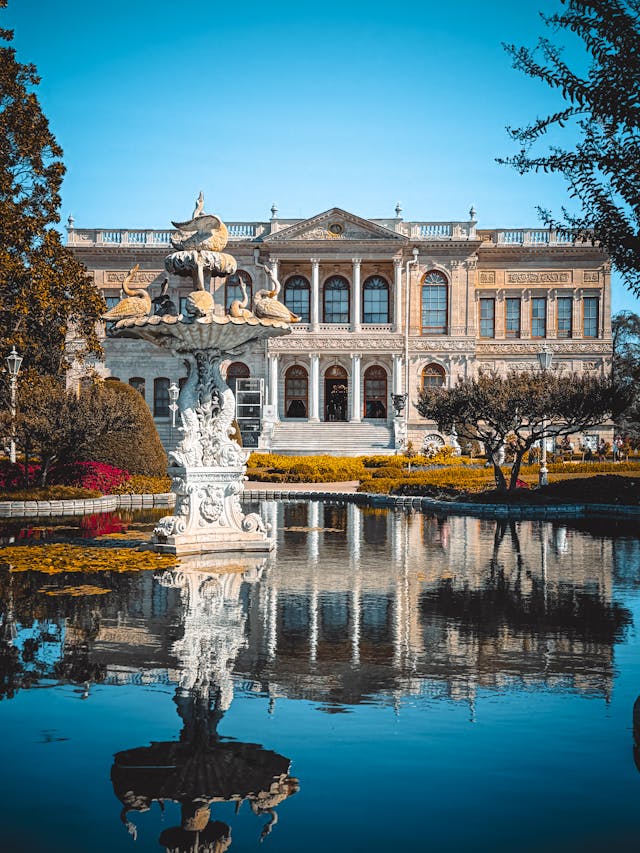
Dolmabahce Palace
The area where Dolmabahçe Palace is located was originally a bay that had served as a natural harbour since antiquity. It is thought to be from here that Sultan Mehmed II (The Conqueror) had his ships hauled over a wooden ramp so as to launch them into the Golden Horn. The Ottoman naval fleet used to anchor in the bay and naval ceremonies were held here. The bay was filled in from the 17th century onwards, and so given the name “Dolmabahçe” (filled garden) and was used as an Imperial Garden. All the buildings in the complex prior to the 19th century were named “Beşiktaş Waterfront Palace”.
During the reign of Sultan Abdülmecid (1839-1861), Beşiktaş Waterfront Palace which had become impractical, was demolished and Dolmabahçe Palace was constructed by the imperial architects Karabet Balyan, Ohannes Serveryan, Nikogos Balyan and James William Smith. Two building supervisors, Hacı Said Aga (1843-1850) and (1850-1856) Esseyid Ali Şahin Bey were commissioned.
The palace was inhabited from the year 1856 by six Sultans and the last Caliph: Sultan Abdülmecid (1839-1856), Sultan Abdülaziz (1861-1876), Sultan Murad V (1876), Sultan Abdülhamid II (1876-1909), Sultan Mehmed Reşad V (1909-1918) Sultan Mehmed VI Vahideddin (1918-1922) and the last Caliph Abdülmecid (1922-1924). After the foundation of the Republic, Mustafa Kemal Atatürk stayed temporarily in the palace for a total of 4 years, between 1927-1938. He worked from the palace and passed away there. The palace was used as a presidential residence during the term of İsmet İnönü till the year 1949, and was opened to public as a palace-museum with its original furnishings in 1984. Apart from its main building parallel to the Bosphorus, Dolmabahçe Palace consists of diverse buildings used for specific purposes, including a glass factory, foundry, aviary and stables. The complex also includes the Apartment of the Crown Prince as well as the Clock Tower and Departure Kiosks behind the Apartment of the Crown Prince constructed during Sultan Abdülhamid II’s reign (1876-1909).
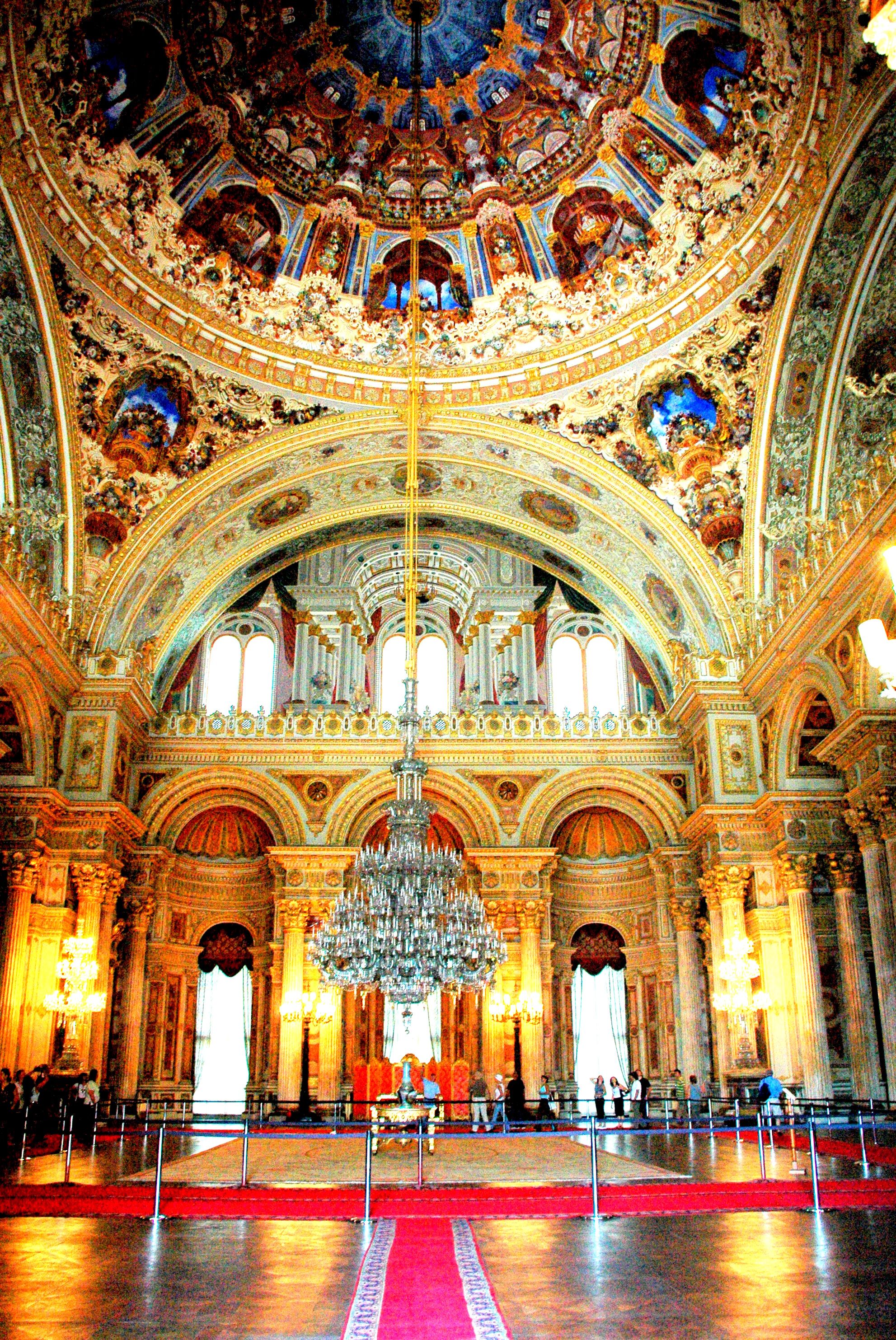
The main structure that consists of two regular floors, one attic and one basement, is divided into three sections with separate functions. These are the Administrative Section (Mabeyn-i Hümâyûn) where the country’s affairs were discussed, the Private Section (Harem) where the Sultan and his family were living and between these the Grand Ceremonial Hall where Sultan received notables of the state on religious days and where state ceremonies were held. The palace has 285 rooms, 44 halls, 68 toilets and 6 Turkish baths. As a monoblock building, it is the biggest palace in Turkey with a ground area of 14.595 m2.
Functionally and architecturally, the palace preserves the traditional Turkish house layout of a hall in the middle with rooms surrounding it; nevertheless, Western decoration in styles such Baroque, Rococo, Neo-Classic were widely used. Thus, traditional Ottoman stylistic and cultural elements were blended with a Western approach, resulting in a new interpretation.
Hereke carpets, Baccarat crystals, Sèvres and Yıldız porcelains, gifts by various state leaders and paintings by Western artists were used for the decoration of the walls and floors of the palace.
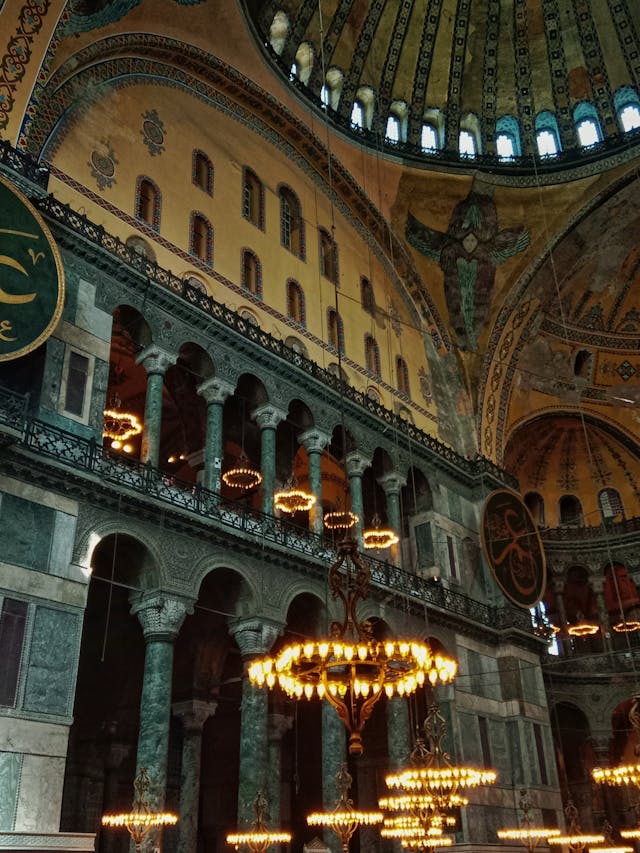
Hagia Sophia
Among the most important monumental architectural works that have survived to the present day, Hagia Sophia holds a very special place for both its architecture and grandeur, and its functionality.
The Hagia Sophia History and Experience Museum, located in the famous Defter-i Hakani Nezareti building in the Sultanahmet Square, narrates the 1700-year history of Hagia Sophia in its 13 halls spread over approximately 3200 m2 of closed area.
In the museum, Hagia Sophia's history from both the Byzantine and Ottoman periods is presented with a captivating visual and auditory manner, with 23 different language options, thanks to the latest technologies. The museum includes four sections in which a large part of the Hagia Sophia collection, most of which are displayed for the first time, is exhibited: Church, Mosque, Museum, and Mosque again. In addition, a cistern dating back to the Byzantine era can be seen through the windows of on the ground floor of the building.
The Hagia Sophia History and Experience Museum offers a unique experience for those who want to experience the rich history of Hagia Sophia from a holistic perspective.